The short version
To file one week's WH-347:
- Fill the header: project, contract number, payroll number (1, 2, 3...), your business, the project location, the wage determination number and modification in your contract, and the week ending date.
- One row per worker per classification. Put the daily hours on the ST line and the overtime hours on the OT line, then the week's total.
- Rates actually paid (ST and OT), fringe credit for plans (6B), fringe paid in cash (6C), gross for this project (7A) and for all work (7B), every deduction, and net pay.
- On page 2, check statements 1, 2, 3 and 6 always; check 4 if anyone was paid as an apprentice and 5 if fringe was paid; list apprenticeship programs and fringe plans; sign and date.
- Send it to your prime (if you are a sub) or the agency within 7 days of payday, every week there is covered work.
The WH-347 is the Department of Labor's form for the weekly certified payroll that Davis-Bacon and Related Acts contracts require. The form itself is optional: you can use any format that carries the same information and the same Statement of Compliance [29 CFR 5.5(a)(3)(ii)(B)]. Most agencies and primes accept the WH-347, and DOL estimates it takes about 55 minutes to complete [DOL]. The current version is Rev. January 2025, OMB No. 1235-0008, which expires 01/31/2028.
Download the form
- Blank WH-347, Rev. January 2025 (PDF, dol.gov). DOL's PDF is print-only; it has no fillable fields. Our unchanged copy: wh-347-rev-jan-2025-blank.pdf.
- DOL's online fillable WH-347, if you want to type one in a browser.
- The worked example from this page, filled in (PDF). Fictional company and workers, real WD rates.
- DOL's own annotated guide (PDF), a two-page picture of the form with callouts.
Who files it, when, and where
Who: every contractor and subcontractor with laborers or mechanics on the site of a Davis-Bacon covered contract over $2,000 [29 CFR 3.3]. The prime is responsible for getting every sub's payrolls in [29 CFR 5.5(a)(3)(ii)(A)].
When: weekly, for each week in which covered work is performed, delivered within 7 days after the regular payment date for that payroll period [29 CFR 3.4(a)]. Pay every two weeks? You still file one WH-347 per workweek.
Where: to the federal agency if it is a party to the contract, otherwise to the applicant, sponsor or owner that passes them to the agency [29 CFR 5.5(a)(3)(ii)(A)]. As a sub, that usually means your prime, often through a system the prime or agency chose (LCPtracker is common; LCPtracker says there is no cost to contractors for filing in an agency's system [LCPtracker]).
How long to keep it: at least 3 years after all the work on the prime contract is completed [29 CFR 5.5(a)(3)(ii)(G)].
Late or missing payrolls cost money. If you do not submit them, the agency can suspend further payments on the contract after written notice, and failure to submit can be grounds for debarment [29 CFR 5.5(a)(3)(iv)(B)].
The form, annotated
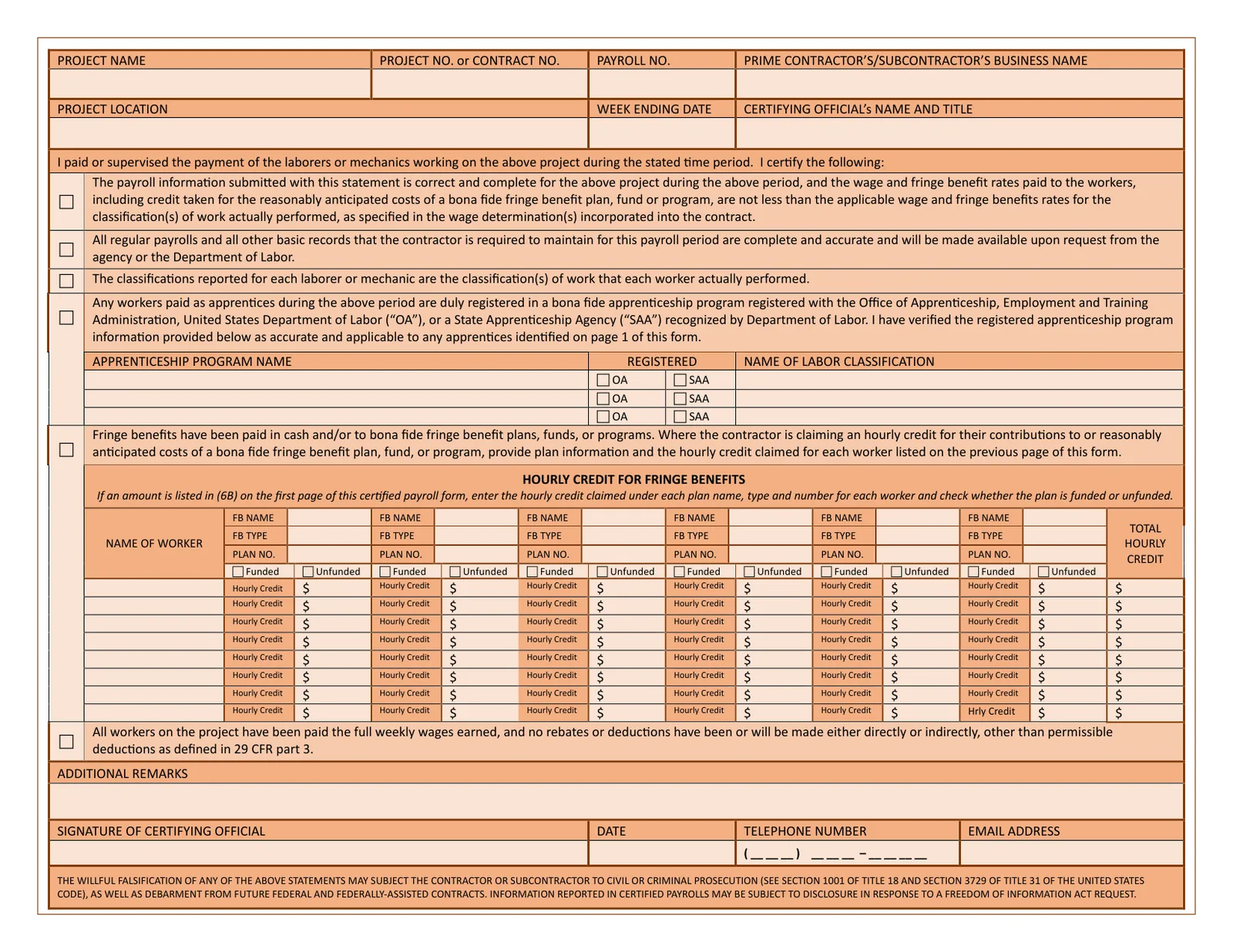
These are the two pages of DOL's form. Select a pin to jump to the explanation. Orange pins are the boxes behind most returned payrolls.
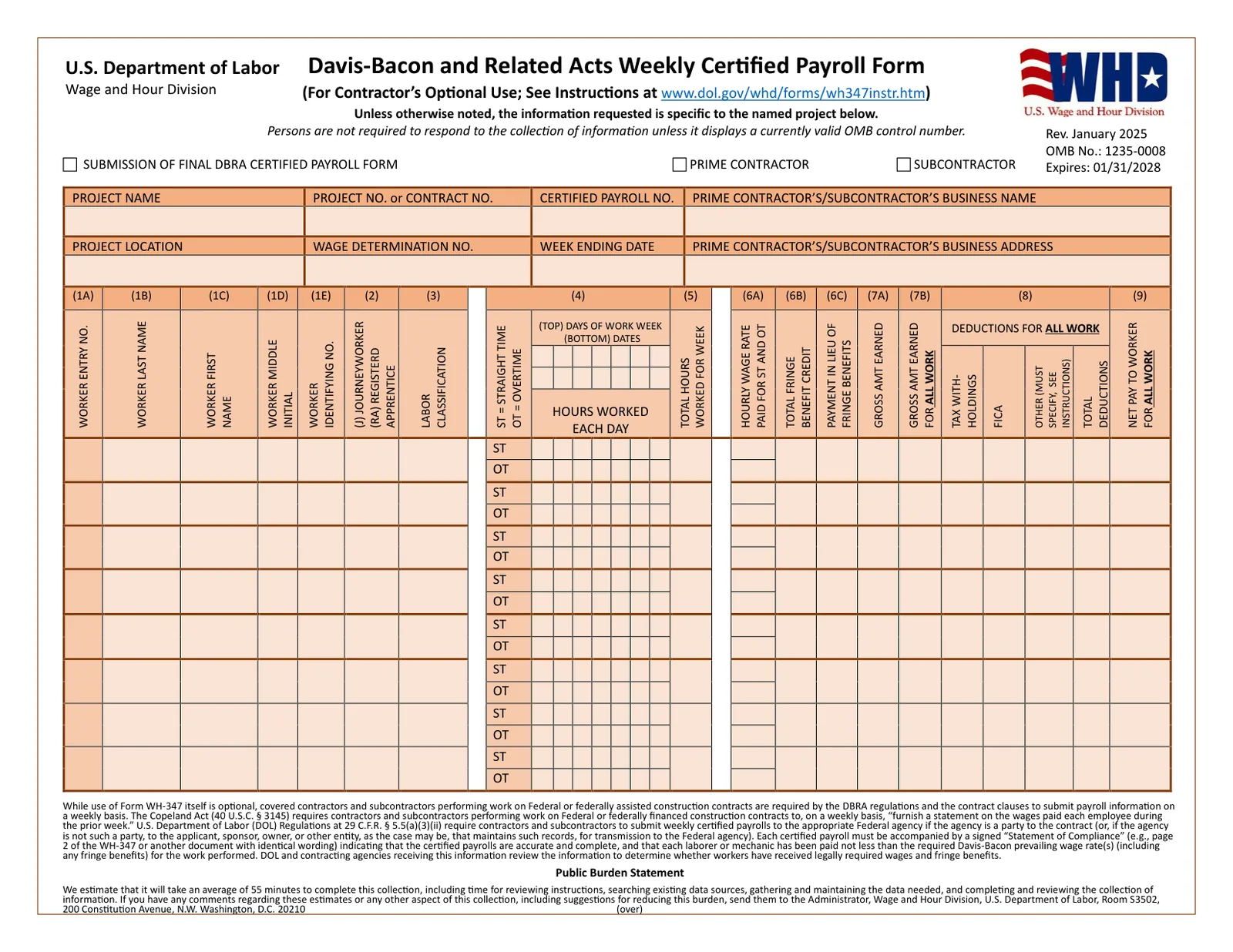
Page 1 header, box by box
The header says whose payroll this is, for which project and which week. The DOL instructions quoted below are from the WH-347 instructions page.
- F
Submission of final DBRA certified payroll form
Check it only on the payroll for your last week of work on the project. "Mark the box to indicate that this submission is for the final week of work on the project for the contractor or subcontractor."
Common mistake: marking a payroll final and then working another week. Primes use the final payroll to close you out.
- P
Prime contractor or subcontractor
Check one. If you were hired by the general contractor (or by another sub), check Subcontractor.
- H1
Project name
"Enter the name of the project on which you are reporting." Use the name on the contract or bid documents so the reviewer can match it.
Example:
Westside Library Renovation - H2
Project no. or contract no.
The project number or prime contract number assigned by the contracting agency, if you have it. Subs: ask your prime for it before the first payroll.
- H3
Certified payroll no.
"Beginning with the number '1', each weekly certified payroll that a contractor or subcontractor submits for a project should be given a payroll number." DOL's annotated guide adds that payrolls are numbered sequentially, based on the weeks worked under the contract. A corrected payroll keeps its original number.
Example:
7for your seventh week on the job. - H4
Business name
"Enter the business' legal name." The legal name, not a trade name, so it matches your contract and registration.
- H5
Project location
"Enter the complete address of the project, or, if there is no specific address, a description of the project location, including, at a minimum, the county or counties and state in which the project is located."
- H6
Wage determination no.
"Enter the wage determination number(s) and revision number(s) included in the covered contract." If more than one WD applies to the work done this week (for example building and heavy), list all of them.
Use the WD and modification written into your contract, not the newest one on SAM.gov. A WD is generally locked in at contract award; later modifications do not apply to an awarded contract except in limited cases such as added out-of-scope work or option extensions [29 CFR 1.6(c)].
Example:
OH20260078, Mod 1. Find yours with the WD lookup. - H7
Week ending date
"Enter the workweek ending date for this pay period." That is the last day of your workweek, not the pay date. If your workweek runs Sunday to Saturday, it is the Saturday.
Common mistake: putting the check date, or one date for a two-week pay period. Split bi-weekly payrolls into two weeks.
- H8
Business address
"Enter the company's full business address."
Page 1 columns 1A to 9
Each worker gets a row with two lines: ST (straight time) on top and OT (overtime) below. Page 1 holds 8 rows. More workers? Use more page 1 sheets and keep counting: "row 1 on page 2 may be entry 9 and row 1 on page 3 may be entry 17."
- 1A
Worker entry no.
Number the rows 1, 2, 3... If a worker did work in more than one classification this week, give each classification its own row and use the same entry number on each of that worker's rows.
- 1B
Last name, first name, middle initial (1B, 1C, 1D)
Self-explanatory. Spell names the same way every week; a changed spelling makes a reviewer think it is a new worker.
- 1E
Worker identifying no.
"Enter each worker's individual identifying number (e.g., last four digits of the worker's social security number or any number specific to the individual worker)... Note: workers' full Social Security numbers must not be included."
The weekly payroll must not carry full SSNs or home addresses [29 CFR 5.5(a)(3)(ii)(B)]. You still keep them in your own records, and must provide them if the agency or DOL asks. (California's state payroll rules differ; see certified payroll in California.)
Example:
4417 - 2
J or RA
"J" for a journeyworker, "RA" for a registered apprentice in a program registered with DOL's Office of Apprenticeship or a recognized State Apprenticeship Agency. "For registered apprentices, also list their level of progression within the approved program."
Only individually registered apprentices may be paid less than the WD rate. Anyone you pay an apprentice rate who is not registered, or who is over the allowed apprentice ratio, must be paid the full WD rate for the work done [29 CFR 5.5(a)(4)(i)].
Example:
RA 3(third period) - 3
Labor classification
The classification of work actually performed, taken from the wage determination(s) in the contract. Not the job title from your payroll system. If no classification on the WD fits the work, "contact the Contracting Officer or Agency representative immediately" (that starts a conformance request).
One row per classification. "If the contractor did not maintain an accurate breakdown of hours worked by a worker in each labor classification, the worker must be paid for all hours worked using the highest applicable prevailing wage rate."
Example:
Electrician(WD row ELEC0683-007) - 4
Days, dates and hours worked each day
Top row: the first letter of each day of your workweek; second row: the dates. Then the hours: straight time on the ST line, overtime on the OT line, under the day they were worked.
On contracts covered by the Contract Work Hours and Safety Standards Act (generally contracts over $100,000), hours over 40 in the workweek are overtime, counting hours worked on and off this project [40 U.S.C. 3702]. Some states also require daily overtime on state public works; see your state guide.
Example: worked 8, 8, 10, 10, 10 Monday to Friday = 46 hours. Friday is 4 ST and 6 OT.
- 5
Total hours worked for week
"Enter the total number of the hours worked entered in column four." ST plus OT for this row.
- 6A
Hourly wage rate paid for ST and OT
The rate actually paid: straight-time rate on the top line, overtime rate on the bottom line. If you paid more than the WD, enter what you paid. "Note: do not include cash payments in lieu of fringe benefits in this column."
The ST rate must be at least the WD base rate for the classification (for apprentices, the program's percentage of the journeyworker rate). Overtime must be at least 1.5 times the basic rate, and fringe is left out of the overtime math [29 CFR 5.32].
Example: ST
43.00, OT64.50(1.5 × $43.00) - 6B
Total fringe benefit credit
The total you contributed to, or reasonably expect to pay for, bona fide fringe benefit plans for this worker this week, as listed on page 2. "This amount should equal the worker's total hours worked in this period multiplied by the hourly credit for fringe benefits as listed under the Total Hourly Credit column on page 2."
Plan credit is generally annualized: the hourly credit is the plan cost divided by all hours the worker works in the year, covered and private [29 CFR 5.25(c)]. Unfunded plans need DOL approval before you take credit [29 CFR 5.28].
Example: 46.00 h × $23.10 =
1,062.60 - 6C
Payment in lieu of fringe benefits
Cash you paid the worker instead of fringe benefits. "This amount should equal the worker's total hours worked in this period multiplied by the hourly rate provided to the worker as cash in lieu of fringe benefits." Cash in lieu is allowed and counts toward the fringe obligation [29 CFR 5.31].
Example: 46.00 h × $3.27 =
150.42 - 7A
Gross amount earned (this project)
"Enter the worker's gross amount earned for the workweek for hours worked on this Federal or federally assisted project." We include cash paid in lieu of fringe (6C) here, because it is paid to the worker as wages and is in the worker's gross pay. DOL's instructions do not say this in so many words; if your agency wants it shown another way, follow them.
Example: $1,720.00 ST + $387.00 OT + $150.42 cash fringe =
2,257.42 - 7B
Gross amount earned for all work
If the worker also earned money this week on other jobs, including private work, enter the total gross for all work here. If not, 7B equals 7A.
- 8
Deductions for all work
Every deduction from the 7B gross: tax withholdings, FICA, other, and the total. "If a worker worked on other jobs in addition to this project, do not pro-rate the deductions; instead, show actual deductions from the worker's weekly gross wage for all projects."
"Other" must be explained: one deduction, describe it in Additional Remarks on page 2; more than one, attach an addendum listing each with its amount. Deductions not on the list in 29 CFR 3.5 need DOL approval first [29 CFR 3.5]. A label like "insurance" by itself is not enough for most reviewers.
- 9
Net pay to worker for all work
"Enter the actual dollar amount paid to the worker for all hours worked across all projects (including non-DBRA covered projects) during the week." 7B minus total deductions, to the cent.
Page 2: the Statement of Compliance
Page 2 is the signed statement that makes the payroll "certified". It repeats the header, then six statements. They are not numbered on the form, but DOL's instructions call them boxes 1 to 6. The full walkthrough is on the Statement of Compliance page; the essentials:
- C
Certifying official's name and title
The person (contractor, subcontractor, or their agent) "who paid or supervised the payment of the workers". This person signs at the bottom.
- 1
Payroll correct; rates and fringe at least the WD
Always checked.
- 2
Records complete and available on request
Always checked.
- 3
Classifications are the work actually performed
Always checked.
- 4
Apprentices are registered
Check it if anyone on page 1 was paid as an apprentice, and fill the table: program name, OA or SAA, and the classification. No apprentices: leave the box unchecked and write "N/A" under program name. More than three programs: attach an addendum.
- 5
Fringe benefits paid; hourly credit table
Check it when fringe was paid in cash, to plans, or both. If you claim plan credit (column 6B), fill the hourly credit table: for each worker, each plan's name, type, plan number, funded or unfunded, the hourly credit, and the total hourly credit. Paid fringe only in cash? "Check the box but do not complete the subsection, because those payments will be reported under column 6C."
- 6
Full wages paid; no rebates; only permitted deductions
Always checked. "Boxes 1, 2, 3 and 6 (i.e., the first three boxes and the last box) always must be checked."
- R
Additional remarks
Optional, but this is where a single "Other" deduction is described, and where you explain anything unusual (a split bi-weekly period, a corrected payroll, a rate source).
- S
Signature, date, telephone, email
Signed by the certifying official. "Legally valid electronic signatures are acceptable... Note: Photocopies or scanned copies of signatures do not satisfy this requirement." The statement does not need a notary, but it is covered by 18 U.S.C. 1001: a fine, up to 5 years in prison, or both for a false statement.
Worked example: two workers, overtime, an apprentice, fringe both ways
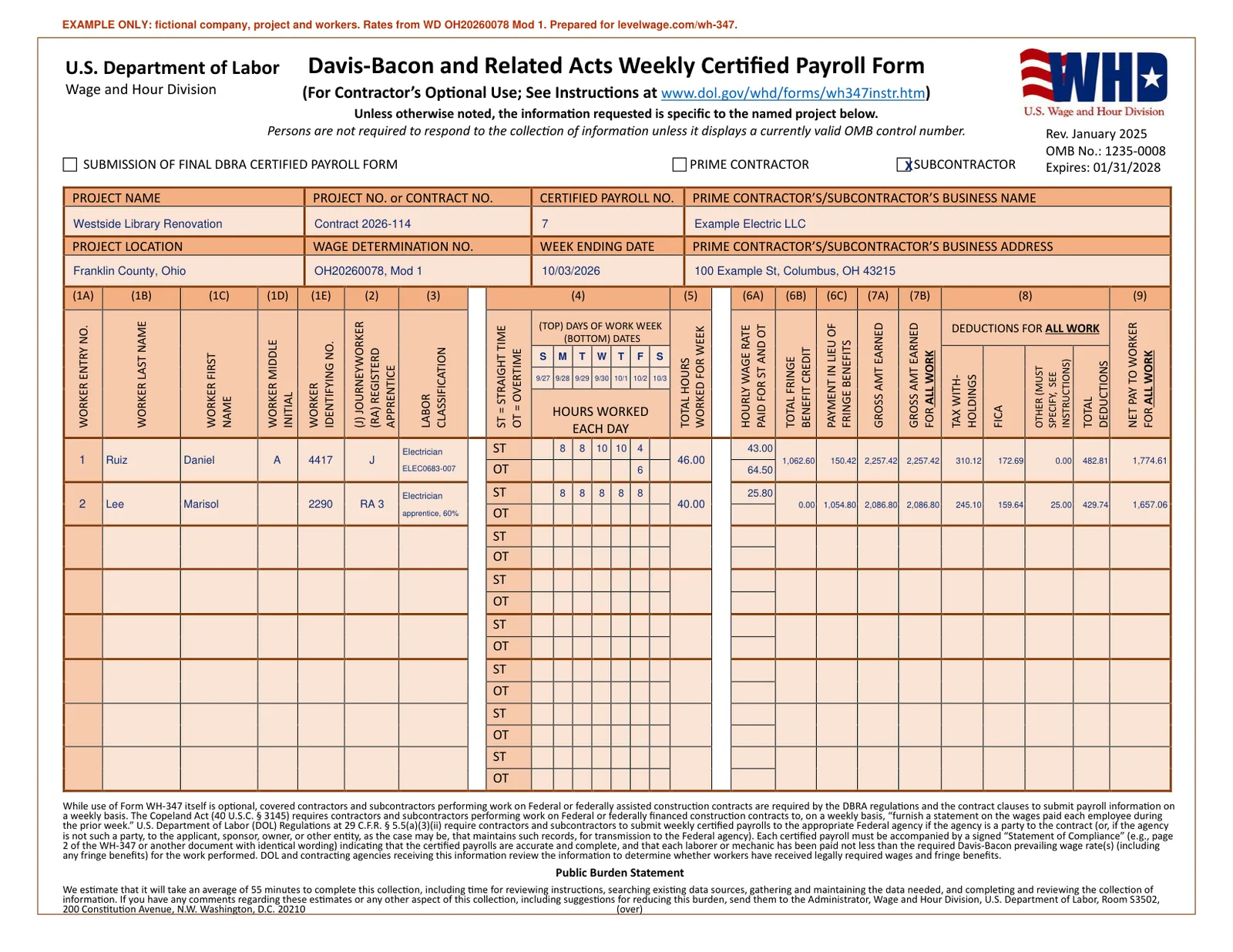
A sub, Example Electric LLC, is on a federally funded library renovation in Franklin County, Ohio. The contract carries wage determination OH20260078, Mod 1 (published May 18, 2026), building construction. The classification for this work is:
| Classification (WD row ELEC0683-007) | Base | Fringe | Total |
|---|---|---|---|
| Electrician (excludes installation of HVAC/temperature controls and low voltage wiring) | $43.00 | $26.37 | $69.37 |
The company, the project and the workers are fictional; the rates are real. The workweek is Sunday to Saturday, week ending Saturday 10/03/2026, payroll number 7. Tax and FICA amounts are example figures; your payroll system computes the real ones.
Worker 1: Daniel Ruiz, journeyworker, overtime, fringe to plans plus cash
Ruiz, Daniel · ID 4417 · J · Electrician
Worked 8, 8, 10, 10, 10 hours Monday to Friday: 46 hours. The first 40 are straight time, so Friday is 4 ST + 6 OT.
| Line | S 9/27 | M 9/28 | T 9/29 | W 9/30 | T 10/1 | F 10/2 | S 10/3 | Total |
|---|---|---|---|---|---|---|---|---|
| ST | 8 | 8 | 10 | 10 | 4 | 40 | ||
| OT | 6 | 6 |
The company pays into two funded plans for him: health and welfare at $14.10 an hour and a defined contribution pension at $9.00 an hour (hourly credits after annualizing the yearly cost over all his hours). That is $23.10 of the $26.37 fringe. The other $3.27 an hour is paid to him in cash.
| Line | Math | Amount |
|---|---|---|
| 6A straight-time rate | WD base, paid exactly | $43.00 |
| 6A overtime rate | 1.5 × $43.00 | $64.50 |
| Straight-time pay | 40.00 h × $43.00 | $1,720.00 |
| Overtime pay | 6.00 h × $64.50 | $387.00 |
| 6B fringe credit to plans | 46.00 h × $23.10 | $1,062.60 |
| 6C cash in lieu of fringe | 46.00 h × $3.27 | $150.42 |
| 7A gross, this project | $1,720.00 + $387.00 + $150.42 | $2,257.42 |
| 7B gross, all work | no other work this week | $2,257.42 |
| 8 tax withholdings (example) | from payroll | $310.12 |
| 8 FICA | 7.65% × $2,257.42 | $172.69 |
| 8 total deductions | $310.12 + $172.69 | $482.81 |
| 9 net pay | $2,257.42 − $482.81 | $1,774.61 |
Fringe check: $23.10 plan credit + $3.27 cash = $26.37 for each of the 46 hours, overtime hours included. Met. Note the fringe on overtime hours is the straight $26.37, not 1.5 times it, and the overtime rate is 1.5 times the $43.00 base only.
Worker 2: Marisol Lee, registered apprentice, fringe in cash
Lee, Marisol · ID 2290 · RA, period 3 · Electrician apprentice
Worked 8 hours a day Monday to Friday: 40 hours, no overtime.
| Line | S 9/27 | M 9/28 | T 9/29 | W 9/30 | T 10/1 | F 10/2 | S 10/3 | Total |
|---|---|---|---|---|---|---|---|---|
| ST | 8 | 8 | 8 | 8 | 8 | 40 | ||
| OT | 0 |
She is individually registered in an apprenticeship program registered with the Office of Apprenticeship. In this example the program's wage schedule pays period 3 apprentices 60% of the journeyworker rate, and the program does not set an apprentice fringe amount. When the program does not specify fringe, apprentices get the full WD fringe [29 CFR 5.5(a)(4)(i)(B)]. The company pays it to her in cash.
| Line | Math | Amount |
|---|---|---|
| 6A straight-time rate | 60% × $43.00 | $25.80 |
| Straight-time pay | 40.00 h × $25.80 | $1,032.00 |
| 6B fringe credit to plans | none | $0.00 |
| 6C cash in lieu of fringe | 40.00 h × $26.37 | $1,054.80 |
| 7A and 7B gross | $1,032.00 + $1,054.80 | $2,086.80 |
| 8 tax withholdings (example) | from payroll | $245.10 |
| 8 FICA | 7.65% × $2,086.80 | $159.64 |
| 8 other: credit union savings | voluntary, 29 CFR 3.5(e) | $25.00 |
| 8 total deductions | $245.10 + $159.64 + $25.00 | $429.74 |
| 9 net pay | $2,086.80 − $429.74 | $1,657.06 |
Apprentice checks: she is registered, the rate matches her period's percentage, she is within the program's ratio of apprentices to journeyworkers (checked day by day), and statement 4 on page 2 is checked with her program listed. If any of those fail, she must be paid the full electrician rate of $43.00 plus $26.37.
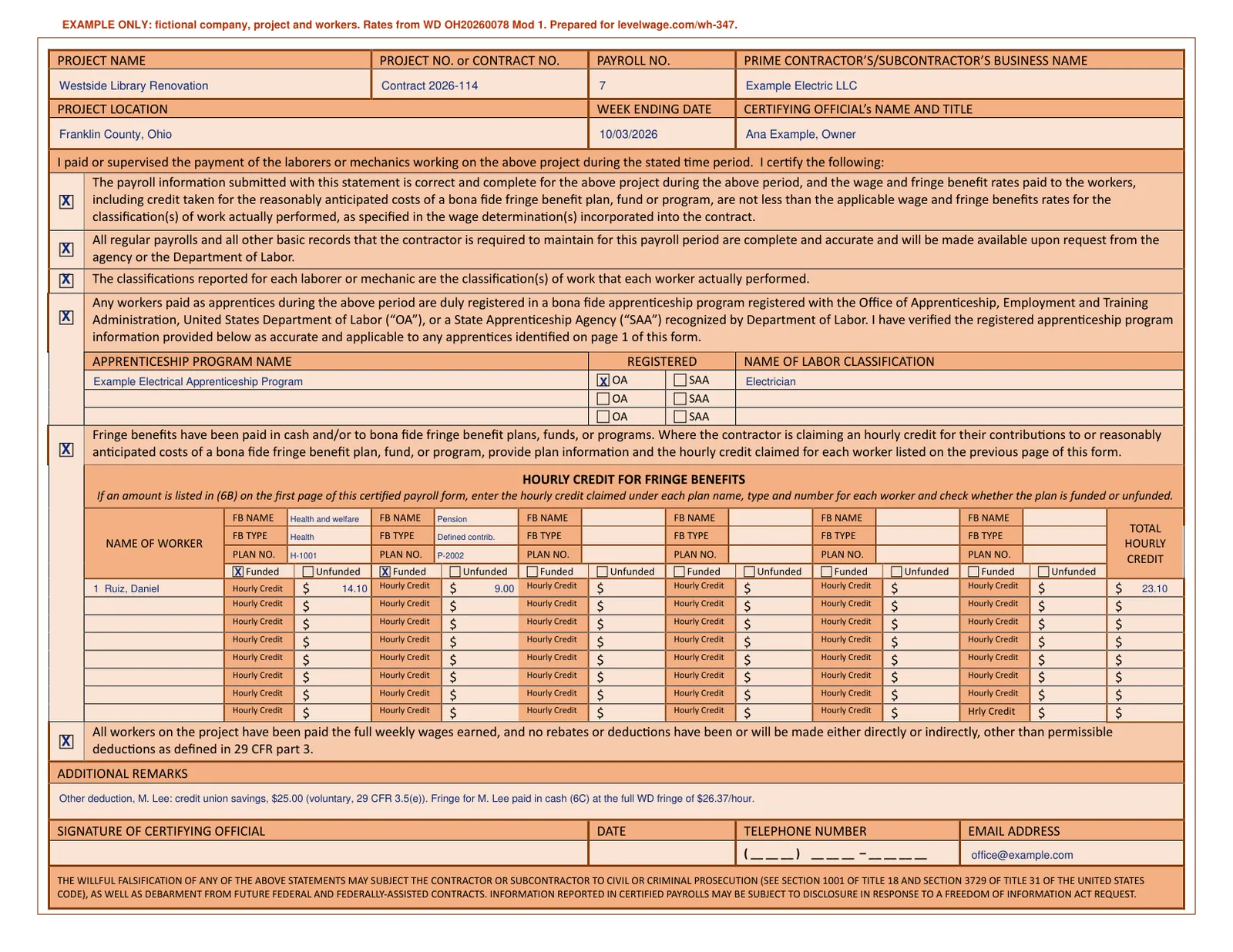
Page 2 for this payroll
- Statements 1, 2, 3 and 6 checked.
- Statement 4 checked. Program table: "Example Electrical Apprenticeship Program", OA, Electrician.
- Statement 5 checked. Hourly credit table: Ruiz, plan 1 "Health and welfare" (type health, plan H-1001, funded) $14.10; plan 2 "Pension" (defined contribution, plan P-2002, funded) $9.00; total hourly credit $23.10. Lee is paid in cash only, so she has no row.
- Additional remarks: "Other deduction, M. Lee: credit union savings, $25.00 (voluntary, 29 CFR 3.5(e))."
- Signature and date left blank until the certifying official signs.
Why payrolls get sent back
From DOL's own certified payroll training, HUD's payroll review handbook and agency checklists. Some agencies do not physically return a bad payroll; they ask for a corrected one and hold payment until it arrives.
- Not submitted every weekA missing week, or payrolls sent in batches. Agencies can suspend payment after written notice. Fix: one payroll per workweek, including no-work weeks if your agency wants them. [DOL]
- Wrong or missing WD numberThe WD on the payroll does not match the contract, or the newest mod is used instead of the contract's. Fix: copy the WD and mod from the contract. [29 CFR 1.6]
- Classification not on the WDTitles like "journeyman", "helper" or "foreman" instead of a WD classification. Fix: use the WD's wording; request a conformance if nothing fits. [HUD 1344.1]
- Rate below the WDBase rate under the WD for the classification, or an apprentice rate for someone not registered. Fix: pay restitution and submit a corrected payroll. [HUD 1344.1]
- Fringe not paid on every hourFringe left off overtime hours, or credit taken for a plan that does not support the amount. Fix: fringe × all hours; keep plan documents. [DOL]
- Overtime on the wrong baseOT computed on base plus fringe, or not paid over 40 hours. Fix: 1.5 × the basic rate; fringe stays straight. [HUD guide]
- Full SSN or home address on the payrollThe weekly transmittal must show only an identifying number. Fix: last 4 digits only. [29 CFR 5.5]
- Unsigned or wrongly signed statementPage 2 missing, unsigned, signed with a stamp or a scanned copy, or by someone who does not supervise pay. Fix: original or valid e-signature by the certifying official. [DOL]
- Required boxes not checkedStatements 1, 2, 3 and 6 must always be checked; 4 when apprentices worked; 5 when fringe was paid. Fix: check them every week. [DOL]
- Unexplained "Other" deductionsAn "Other" amount with no description, or a vague one like "insurance". Fix: describe it in remarks, or attach an addendum for several. [HUD guide]
- Math that does not add upDaily hours that do not total, gross that is not hours × rate, net that is not gross minus deductions. Fix: recompute every line before you sign. [HUD 1344.1]
- Missing apprentice paperworkNo program name or registration, or more apprentices than the ratio allows on a given day. Fix: fill the program table; keep registration records. [DOL]
- Sub payrolls missingThe prime is responsible for all subs' payrolls, so a late sub holds up the prime's payment. Fix: send yours on time; primes notice. [29 CFR 5.5]
- Payroll does not match other recordsHours on the payroll differ from sign-in sheets, daily reports or worker interviews. Fix: build the payroll from the same time records. [HUD 1344.1]
What changed from the old form
OMB approved the revised WH-347 on January 6, 2025, and the new form carries "Rev. January 2025" [OMB]. DOL said it was revising the form "to simplify and clarify certain fields and to obtain more specific information about fringe benefits" [89 FR 70670]. The previous form was "Revised December 2008". The differences, from comparing the two PDFs:
| Area | Old form (Dec. 2008) | New form (Jan. 2025) |
|---|---|---|
| Title | Payroll | Davis-Bacon and Related Acts Weekly Certified Payroll Form |
| Final payroll | Nothing | "Submission of final DBRA certified payroll form" checkbox |
| Contractor type | Contractor or subcontractor | Prime contractor or subcontractor |
| Project fields | "Project and location", "Project or contract no." | Separate project name, location, and project or contract no. |
| Wage determination | No field | WD number(s) and revision number(s) |
| Worker identity | One column for name and ID | 1A entry no., 1B to 1D name, 1E identifying no. |
| Column 2 | Number of withholding exemptions | J (journeyworker) or RA (registered apprentice) with level |
| ST and OT lines | OT on top, ST below | ST on top, OT below; day letters and dates in the header |
| Rate and fringe | One "rate of pay" column; cash fringe could be combined with the rate | 6A rate paid (no cash fringe), 6B fringe plan credit, 6C cash in lieu |
| Gross pay | One cell split diagonally, project and all work | 7A this project, 7B all work |
| Deductions | FICA, withholding, two blanks, other, total | Deductions for all work: tax, FICA, other (must specify), total; no pro-rating |
| Page 2 | Fill-in-the-blank paragraphs, fringe "4(a) plans / 4(b) cash / 4(c) exceptions" | Header block, six checkbox statements, apprenticeship program table, per-worker hourly fringe credit table |
| Apprentice wording | "Bureau of Apprenticeship and Training" | Office of Apprenticeship (OA) or State Apprenticeship Agency (SAA) |
| Signer contact | None | Telephone number and email address |
| Footer warning | Falsification | Falsification, plus debarment and FOIA disclosure |
| Fillable | Print-only PDF; DOL offers an online fillable form | |
| OMB expiration | 09/30/2026 | 01/31/2028 |
The biggest practical change is fringe. On the old form you could write "$43.00/3.27" in the rate column and check a box. Now cash fringe has its own column (6C), plan credit has its own column (6B), and page 2 wants each plan, its number, whether it is funded, and the hourly credit for each worker.
LevelWage fills the January 2025 form, prints the WD number and modification on every report, and leaves the signature for you.
Frequently asked questions
Is the WH-347 form mandatory?
Can I still use the old WH-347 (Revised December 2008)?
Is there a fillable WH-347?
Do I file a WH-347 for a week with no work?
Who is allowed to sign the Statement of Compliance?
How long do I keep certified payrolls?
What if a worker did two kinds of work in the same week?
Is overtime 1.5 times the rate plus fringe?
Sources
- DOL WHD: WH-347 form page and instructions
- DOL: WH-347 (Rev. January 2025) PDF
- DOL: WH-347 annotated guide (PDF)
- 29 CFR 5.5, contract provisions (certified payroll at (a)(3))
- 29 CFR 3.3 and 3.4, weekly statement and submission
- 29 CFR 3.5, deductions allowed without approval
- 29 CFR 5.25 and 5.28, fringe benefit credit and unfunded plans
- 29 CFR 5.31 and 5.32, cash in lieu of fringe and overtime
- 29 CFR 1.6, when a wage determination applies
- 40 U.S.C. 3702, overtime over 40 hours (CWHSSA)
- OMB approval of the 2025 WH-347 (ICR 202410-1235-006)
- Federal Register, 89 FR 70670 (Aug. 30, 2024): proposed WH-347 revision
- DOL seminar: Davis-Bacon certified payrolls (PDF)
- DOL seminar: What am I supposed to do with all of these certified payrolls (PDF)
- HUD Handbook 1344.1, chapter 5, payroll review (PDF)
- HUD Contractor's Guide to Davis-Bacon (PDF, hosted by NYC HPD)
- SAM.gov: wage determination OH20260078, Mod 1 (worked example rates)
LevelWage prepares reports for your review. This page explains the rules in plain words; it is not legal advice. When a rule matters to a decision, read the source and your contract.